
You’ve found a car you like, and you open the spec sheet. Your eyes glaze over as you see a sea of numbers and acronyms. You see "1.8L," "2.5L," "3.5L V6," and you know it’s important, but you’re not quite sure why. You’re left with a nagging uncertainty: is this car going to be a fuel-sipping champion or a wallet-draining monster at the petrol station?
This confusion is a major source of anxiety for buyers. Choosing the wrong engine size can lock you into years of unnecessarily high fuel costs—a mistake that can cost you hundreds of thousands of naira over the life of the car.
This is the next article in our Spec-Explained series, where we demystify the technical jargon to give you a clear, competitive advantage. Today, we're decoding engine displacement. Understanding this one number is the single most powerful tool you have to predict your future fuel bill and buy a car that perfectly fits your life and your budget.
What is Engine Displacement? The "Jugs of Water" Analogy
Forget the complex engineering terms. Let’s make it simple.
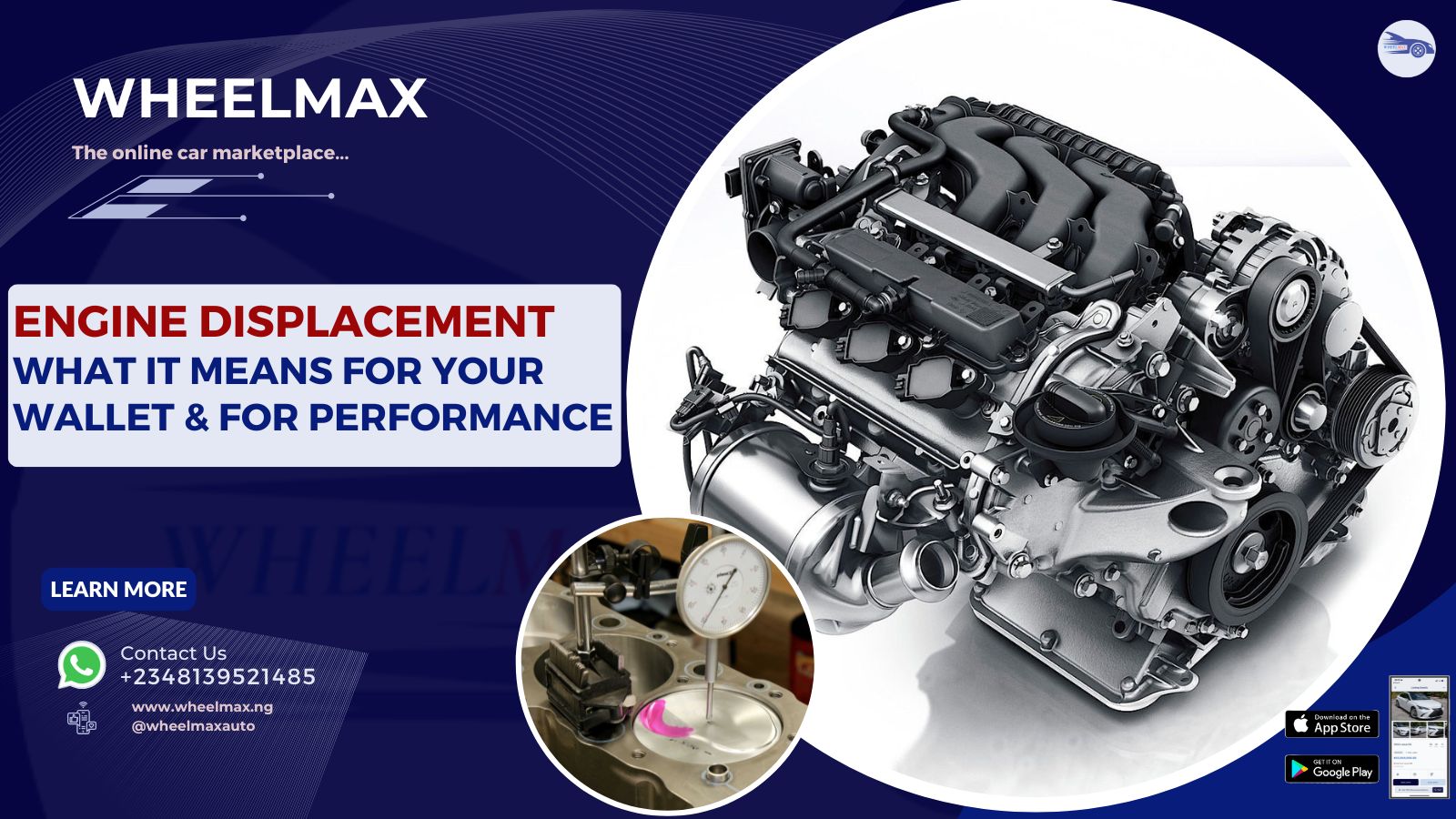
Imagine the cylinders inside an engine are like jugs of water. Engine displacement is the total volume of all those jugs combined. It’s measured in litres (L) or cubic centimetres (cc).
- A car with a 1.8L engine has a total jug volume of 1.8 litres.
- A car with a 2.5L engine has a total jug volume of 2.5 litres.
It’s that simple. The 2.5L engine has bigger "jugs" than the 1.8L engine.
Now, here’s the golden rule that will save you money: Bigger jugs require more liquid to fill them up. In an engine, that "liquid" is a mixture of air and fuel. Therefore:
Bigger Engine (Larger Displacement) = More Power Potential = More Fuel Burned
The Power Twins: Horsepower and Torque
Displacement is directly linked to the two numbers that define a car's power: horsepower and torque.
- Torque (The "Pulling Power"): Think of torque as the engine's initial muscle or twisting force. It’s what gets the car moving from a standstill. High torque is what you feel when you’re pushed back in your seat when the driver accelerates. It's crucial for getting a heavy car moving and for navigating stop-and-go city traffic.
- Horsepower (The "Speed"): Think of horsepower as the engine's stamina or how fast it can work. It’s what allows the car to reach and maintain high speeds on the highway.
A larger displacement (bigger jugs) allows the engine to burn more fuel and air at once, which generally produces more torque and horsepower. But this power always comes at the cost of fuel.
The Nigerian Real-World Scenarios: Which Engine Size is Right for YOU?
This is where the theory meets the road. The best engine size depends entirely on your daily driving reality.
- Your Reality: You spend most of your time in stop-and-go traffic, at speeds below 60 km/h.
- The Smart Choice: A smaller engine (1.5L to 2.0L). In these conditions, a large engine is just dead weight. Its power is unusable, and you're simply burning extra fuel for no reason every time you accelerate from a stop. A smaller, lighter engine is far more efficient in its natural habitat: the city.
- Examples: Toyota Corolla (1.8L), Honda Civic (1.8L/2.0L), Kia Rio (1.6L).
- Your Reality: You spend a lot of time on expressways, maintaining steady speeds.
- The Smart Choice: A mid-size engine (2.4L to 2.5L). Here, a slightly larger engine can be surprisingly efficient. It doesn't have to work as hard to maintain a high speed, running at lower, less "stressed" RPMs. A tiny 1.5L engine might feel like it’s screaming just to keep up, potentially using more fuel than a relaxed 2.5L engine cruising at the same speed.
- Examples: Toyota Camry (2.5L), Honda Accord (2.4L), Hyundai Sonata (2.4L).
- Your Reality: You drive a heavier vehicle, often loaded with family members or goods.
- The Smart Choice: A larger engine with more torque is essential (2.5L, 3.5L V6, or a Diesel). A small engine in a big, heavy SUV would have to work incredibly hard just to get moving. This strain would make it terribly slow, noisy, and shockingly inefficient. The larger engine handles the weight with ease, making it a more effective and often more efficient choice for the job.
- Examples: Toyota Highlander (3.5L), Toyota Prado (4.0L), Toyota Hilux (2.7L/Diesel).
The Wheelmax Verdict: Your Rule of Thumb
Forget the complexity. Here’s your simple guide to choosing the right engine size:
- Mostly city driving? Prioritize a smaller engine (under 2.2L). Your wallet will thank you every day.
- A mix of city and highway? A mid-size engine (2.4L - 2.5L) offers the perfect balance of power and efficiency.
- Driving a heavy 7-seater SUV or a pickup truck? You need the torque of a larger engine (V6 or Diesel). Don't undersize it.
Understanding engine displacement is your first and most powerful step to becoming a truly informed car buyer. You now have the knowledge to look past the marketing and choose a car with an engine that is perfectly tailored to your needs, ensuring you get the performance you want without paying a penalty at the pump.
Ready to find a car with the perfect engine size for you? Use the advanced filters on Wheelmax to search by engine displacement today.