

You're driving down the road, and you see it too late—a monster pothole, a vicious speed bump, or a street that's rapidly turning into a river during a downpour. You hold your breath, grip the steering wheel, and then you hear it: a sickening, gut-wrenching SCRAPE from underneath your car.
It’s a sound every Nigerian driver knows and dreads. It’s the sound of potential damage to your exhaust, your oil pan, or your suspension. It’s the sound of an unplanned and expensive trip to the mechanic.
This entire, stressful experience often comes down to one single, overlooked number on a car's spec sheet: Ground Clearance.
For drivers in many parts of the world, this spec is an afterthought. For us in Nigeria, it is one of the most critical factors for a stress-free and financially sound ownership experience. In this Spec-Explained, we will demystify ground clearance, show you what the numbers really mean, and explain why it should be a top priority in your next car purchase.
What is Ground Clearance? A Simple, Visual Explanation
Forget complex definitions. Let's make it simple.
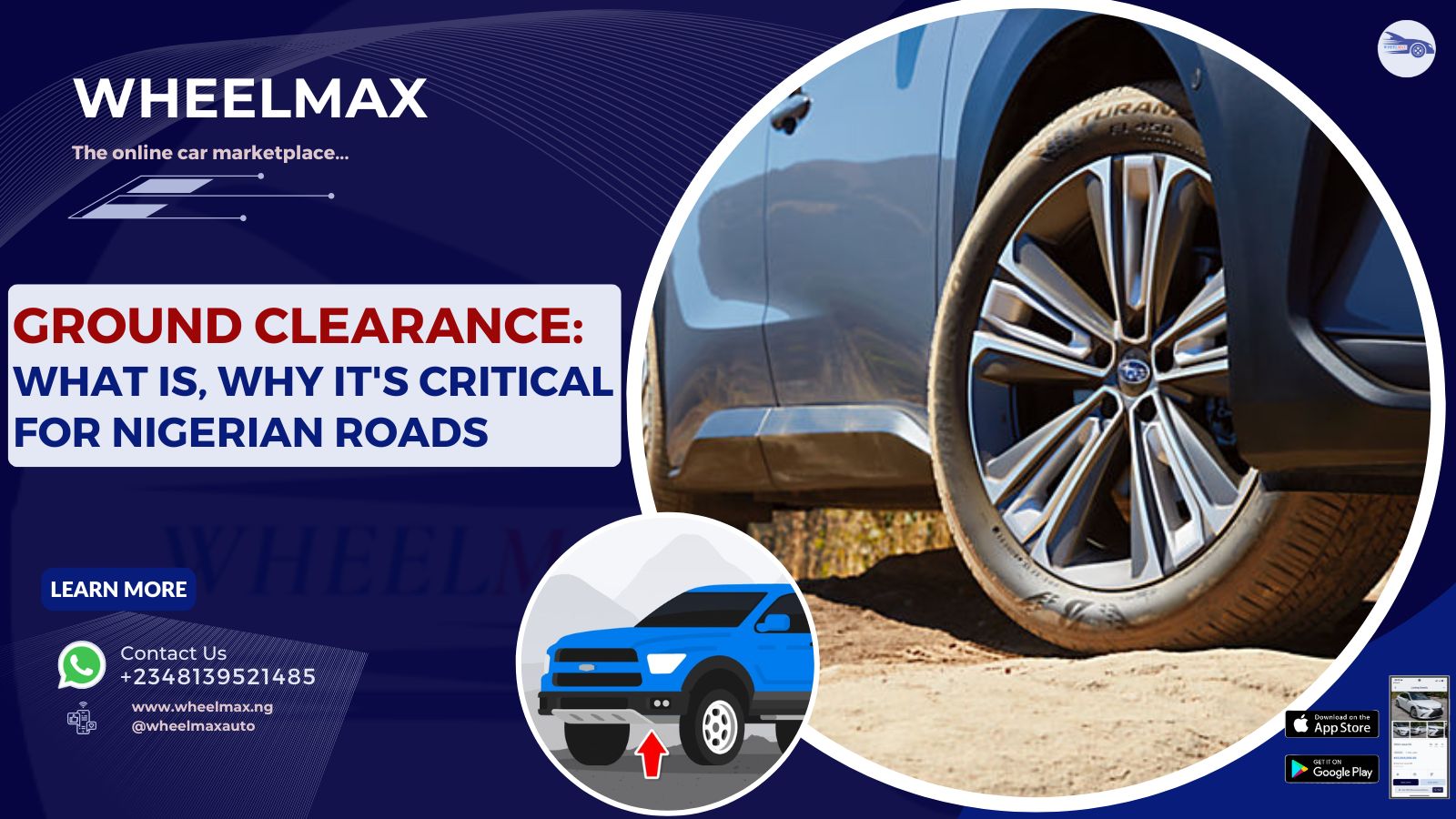
Ground clearance (or ride height) is the minimum distance between the lowest point of your car's underbody and the flat ground.
Imagine your car is parked on a perfectly level surface. The ground clearance is the height of the biggest block you could slide underneath the car without it touching anything.
It's usually measured in millimetres (mm) or inches.
The lowest point is typically a part of the exhaust system, the engine's oil pan, or a suspension component. A higher ground clearance means more space between these vital, expensive parts and the road.
Why is Ground Clearance a Superpower on Nigerian Roads?
Having a good amount of ground clearance is like having a superpower that protects your car and your wallet from three major enemies.
Enemy #1: The Pothole & The "Undulating" Road
Our roads are notoriously uneven. A car with low ground clearance is constantly at risk of "bottoming out"—where the undercarriage violently hits the road surface. This can cause severe damage to your exhaust system (leading to noise and performance issues), your oil pan (leading to a catastrophic oil leak), and other critical components. A car with higher clearance can sail over these imperfections with confidence.
Enemy #2: The "Mountainous" Speed Bump
We've all seen them—speed bumps that look more like small mountains. They are often built without regulation and can be viciously steep. A low car will scrape its front bumper going up and its underbelly coming down. High ground clearance allows you to navigate these obstacles without wincing every time.
Enemy #3: The Flash Flood
During the rainy season, many streets can become flooded in minutes. While you should never drive through deep, standing water, higher ground clearance gives you a crucial advantage in shallow to moderate flooding. It raises the level of your engine's air intake and sensitive electronics, reducing the risk of your engine sucking in water—a catastrophic and often terminal failure known as "hydrolock."
The Numbers Game: A Real-World Guide to Ground Clearance Specs
Okay, so a higher number is better. But what do the numbers actually mean in practice? Here is your Wheelmax guide to interpreting ground clearance specs for the Nigerian market.
Low Clearance (< 140mm): Sports Cars & Performance Sedans
Examples: Many sports sedans (some BMWs, etc.).
The Reality: These cars are designed for perfect, smooth roads. They will be a constant source of stress in Nigeria. You will scrape on speed bumps, you will have to crawl over bad patches of road, and you will live in fear of potholes. Avoid these unless it’s a weekend-only car and you know your routes are perfect.
Standard Clearance (140mm - 165mm): Most Sedans
Examples: Toyota Corolla, Honda Accord, Toyota Camry.
The Reality: This is manageable for most city and highway driving on tarmac roads. You will still need to be very careful with large potholes and unusually high speed bumps, but for the average daily commute, it is adequate.
Good Clearance (170mm - 195mm): Most Crossovers & Compact SUVs
Examples: Toyota RAV4, Hyundai Tucson, GAC GS4.
The Reality: This is the sweet spot for a Nigerian daily driver. This level of clearance gives you a genuine, noticeable increase in confidence. You worry less about bad roads, you can handle most speed bumps with ease, and you have a better margin of safety in minor flooding. This is one of the biggest reasons for the massive popularity of crossovers.
Excellent Clearance (> 200mm): True SUVs & Pickup Trucks
Examples: Honda CR-V, Toyota Prado, Toyota Hilux, Ford Ranger.
The Reality: This is "go-anywhere" territory. This level of clearance means you can tackle truly bad rural roads, construction sites, and significant obstacles with minimal risk. For those who live outside major city centers or need a truly rugged vehicle, this is the spec to look for.
The Wheelmax Verdict
Ground clearance isn't a luxury feature; for a Nigerian driver, it's a core, fundamental specification that directly impacts your peace of mind and long-term running costs.
When you're browsing spec sheets on Wheelmax, don't let this number be an afterthought. Pay close attention to it. A car with an extra 30mm of ground clearance might not look as "sporty," but it will save you from countless moments of stress and potentially thousands in repair bills.
It's the spec that lets you drive with your head held high, instead of constantly looking down for the next pothole.